Friday, December 28, 2012
Expression Francais by Aneke Sandra
YANG BERHUBUNGAN DENGAN MAKANAN
Ungkapan ini juga banyak yang sesuai region masing-masing, contohnya di bagian timur perancis ada ungkapan : "pédaler dans la choucroute" (ngayuh dalam choucroute) yang arti ungkapannya : nggak maju-maju. Secara, choucroute itu kan makanan khas alsacien yang jadi kebanggaan belahan timur perancis. Sedangkan di bagian selatan perancis, ungkapan itu menjadi : "pédaler dans la semoule" (ngayuh dalam semoule). Semoule lebih beken didaerah selatan ! Bahkan ungkapan itu juga menjadi "pédaler dans le yoghurt" dan "pédaler dans la cancoillotte" (nama keju yang lembek)... Halaaah... padahal artinya sama :-)
Pédaler dans la choucroute : masalah nggak ada kemajuan
Avoir du pain sur la planche : banyak kerjaan
Casse bonbon : Menjengkelkan
Avoir le cul bordé de nouilles : Orang yg sangat beruntung
Lune de Miel : bulan madu
YANG BERHUBUNGAN DENGAN KELUARGA
Pousser mamie dans les orties : berlebihan (Il faut quand même pas pousser la mamie dans les orties)
Laver son linge sale en famille : jangan mengumbar urusan memalukan (ruwet) keluarga pada pihak luar
YANG PAKE KATA KATA KASAR :-)
Casse couille : menjengkelkan
Avoir du sable dans le vagin (hahaha) : stress !
Faire chier : mengganggu, atau jangan ganggu
Se faire des couilles en or = dapet banyak rejeki atau orang yg berpenghasilan besar
YANG BERHUBUNGAN DENGAN BINATANG
Manger comme un moineau : nggak doyan makan
Entre chien et loup : antara siang dan malam, maghrib maksudnya
Faire un boeuf : improvisasi dalam pertunjukan musik
YANG BERHUBUNGAN DENGAN CUACA
L'été indien : Musim gugur yang banyak matahari dan panas
Un froid de canard : Biasanya disaat musim dingin, pas temperatur sangat amat dingin...
Se cailler les miches / les meules : kedinginan
YANG BERHUBUNGAN DENGAN WAKTU
A la Saint-Glinglin : Nanti atau lain waktu, saking gk jelasnya kapan lebih cenderung gk kan mungkin tercapai..

Friday, August 10, 2012
Harcelement sexuelle
Marie Claire
=climat équivoque , à base de commentaires égrillards sur le physique (t'as beau p'tit cul etc), y compreis par SMS ou mail, propositions salaces et confidences sexuelles, pornographie imosée (affiches, fonds d'écrans dans un bureau partagé mimiques obscènes (jeux de langue pour mimer une fellation ou un cunnilingus). Puni: un an d'emprisonnement et de 15.000 euros.
Agression sexuelle: toute atteinte sexuelle commice avec violence, contrainte, menace ou surprice (article 222-22). Concrètement, tous les actes sans pénétration (pelotage surprise, mains aux fesses, baisers forcés) et non désirés par la personne qui les subit.
Tuesday, February 21, 2012
LINK !
tempat main di jakarta utk anak bermain peran:
http://www.kidzania.co.id/ver2/index.php?catid=30&artid=72&mnid=113&menu=115
list international school in jakarta:
http://www.expat.or.id/orgs/schools.html
http://www.kidzania.co.id/ver2/index.php?catid=30&artid=72&mnid=113&menu=115
list international school in jakarta:
http://www.expat.or.id/orgs/schools.html
Friday, February 17, 2012


French Children Don't throw food. - bringing up un bebe.
French Children Don't Throw Food by Pamela Druckerman – review
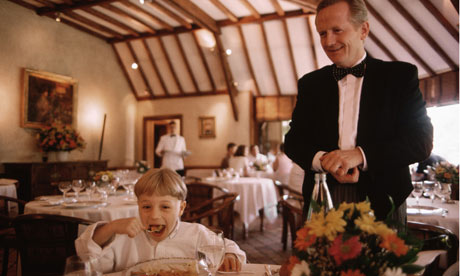 That's the way to do it … a young boy at the Côte d'Or restaurant, Saulieu. Photograph: © Owen Franken/Corbis
Read by 809 people
Friday 20 January 2012Bringing up baby the French way
New Yorker Pamela Druckerman married an Englishman and lived with him in Paris, where she had a baby, closely followed by twins. In England or the US she might have found sympathy and chummed up with similarly sleep-deprived, frazzled new mums. But motherhood in Paris was different.
She found herself in a strange new world where babies slept through the night from two months, ate at adult meal times, often attended nursery from nine months, where they ate a varied and sophisticated diet and didn't throw their dinners about. And the mums were not knackered and spattered with vomit. They looked chic, even sexy, and had their own grown-up lives.
As a journalist and desperate mother, Druckerman was keen to uncover the secret of French parenting. It appeared to "vacillate between being extremely strict and shockingly permissive", but the results were impressive. The parents were not shouting, the children were quiet, patient and able to cope with frustration. Unlike her own intensive and exhausting "Anglophone" method of raising a child, the French seemed to have harnessed an "invisible, civilising force" that made parenting a comparative breeze. Her observations were confirmed by a Princeton research study, which discovered that mothers in Ohio found parenting twice as unpleasant as comparable mothers in Rennes, France.
Druckerman has interviewed parents and experts and compared her findings with American theories and behaviours when making trips home. The result is this self-deprecating, witty, informative but slightly ambivalent bringing-up-baby book. It doesn't seek to give advice, just describes the author's experience – her pain, struggles and triumphs, and sets out the two alternative methods: the calm, pleasant and for the most part enjoyable French experience, versus the fairly hysterical, intense and gruelling Anglophone method, and allows you to choose. She doesn't fall completely for the French method, but on this evidence, I do – though it's three decades too late for me now.
Druckerman was not in love with Paris and disappointed to find that the French mothers, with whom she had expected to make friends, were not keen on bonding with other mothers. They had better things to do. Waiting is the key: the French do not do instant gratification. It starts more or less at birth. When a French baby cries in the night the parents go in, pause, and observe for a few minutes. They know that babies' sleep patterns include movements, noises and two-hour sleep cycles, in between which the baby might cry. Left alone it might "self-soothe" and go back to sleep. If you dash in like an Anglophone and immediately pick your baby up, you are training it to wake up properly. But if a French baby does wake up and cry properly on its own, it will be picked up. Result? French babies often sleep through the night from two months. Six months is considered very late indeed.
French babies continue to wait – when they are babies "long stretches from one feed to the next"; when older until 4 o'clock "gouter" for sweets and cakes (no treats straight from the supermarket checkout); until their mother finishes a conversation, or whatever she's doing at the time. Even toddlers wait contentedly for their food in restaurants.
Doesn't it sound like a heavenly dream? But Druckerman claims to have witnessed it all, and I believe her. This waiting, according to the French "is a first, crucial lesson in self-reliance and how to enjoy one's own company". To believe in it you need to also believe that a baby is capable of learning and able to cope with frustration.
The French have their own experts: Rousseau, Piaget and Françoise Dolto, "the Titan of French parenting", who believed that children are rational and "understand language as soon as they are born", hence you can "explain the world to them". They must be provided with a "cadre" or frame – "setting firm limits for children, but giving them tremendous freedom within those limits". It's a difficult mix to get to grips with. Those boundaries are repressive enough to worry Druckerman. Is she crushing her daughter's spirit, stifling her self-expression? "Repeatedly blocking her urges feels wrong." But the French think children must learn to cope with frustration. It's a core life skill. And "the word 'No' rescues children from the tyranny of their own desires."
Returning home, Druckerman was shocked to see American mothers following their toddlers around playgrounds, commenting loudly on their every move – so different from the more detached French mothers, who sit at the edge of the playground chatting calmly to friends, while leaving their toddlers to get on with it.
French mothers are also calmer about pregnancy: the "French pregnancy press doesn't dwell on unlikely worst-case scenarios". Au contraire, it recommends serenity. There are no terrifying warnings about foodstuffs or sex, or longings for a natural birth. In France 87% of women have epidurals, and don't seem bothered. We may think their system over-medicalised, but France "trumps the US and Britain on nearly every measure of infant and maternal health". And pregnant French women are thinner – particularly in Paris. To them, "food cravings are a nuisance to be vanquished" not indulged because "the foetus wants cheesecake".
The French don't do indulgence either. Their children are trained to eat everything. No pandering to picky eaters. No children's menus in restaurants, and here is one four-course crèche menu: heart of palm and tomato salad, followed by turkey au basilica and rice in a provençal cream sauce, St Nectaire cheese with baguette, kiwi fruit. Not a Turkey Twizzler in sight. Most impressive of all, the French take their nursery teachers seriously. Working in a crèche or nursery is considered a proper, admirable career and requires a degree in "puericulture". Druckerman soon begins to see the care-givers at her daughter's crèche as the "Rhodes scholars of baby care".
But however much she admires "the easy, calm authority" French parents seem to possess when enforcing the cadre, the waiting and the varied diet, will Druckerman manage it herself? Her efforts to do so add a compelling narrative to this fascinating study of French parenting.
• Michele Hanson's What the Grown-Ups Were Doing is published by Simon & Schuster.
• This article was relaunched on 20 January 2012, after temporarily being taken down in line with an embargo, and includes the correct name of the reviewer.
Why French Parents are superior - bringing up un bebe
Why French Parents Are Superior
While Americans fret over modern parenthood, the French are raising happy, well-behaved children without all the anxiety. Pamela Druckerman on the Gallic secrets for avoiding tantrums, teaching patience and saying 'non' with authority.
By PAMELA DRUCKERMAN
Emmanuel Fradin for The Wall Street Journal.


Pamela Druckerman's new book "Bringing Up Bebe," catalogs her observations about why French children seem so much better behaved than their American counterparts.
When my daughter was 18 months old, my husband and I decided to take her on a little summer holiday. We picked a coastal town that's a few hours by train from Paris, where we were living (I'm American, he's British), and booked a hotel room with a crib. Bean, as we call her, was our only child at this point, so forgive us for thinking: How hard could it be?
We ate breakfast at the hotel, but we had to eat lunch and dinner at the little seafood restaurants around the old port. We quickly discovered that having two restaurant meals a day with a toddler deserved to be its own circle of hell.
Bean would take a brief interest in the food, but within a few minutes she was spilling salt shakers and tearing apart sugar packets. Then she demanded to be sprung from her high chair so she could dash around the restaurant and bolt dangerously toward the docks.
Journal Community

Pamela Druckerman's new book "Bringing Up Bebe," catalogs her observations about why French children seem so much better behaved than their American counterparts. She talks with WSJ's Gary Rosen about the lessons of French parenting techniques.
Our strategy was to finish the meal quickly. We ordered while being seated, then begged the server to rush out some bread and bring us our appetizers and main courses at the same time. While my husband took a few bites of fish, I made sure that Bean didn't get kicked by a waiter or lost at sea. Then we switched. We left enormous, apologetic tips to compensate for the arc of torn napkins and calamari around our table.
After a few more harrowing restaurant visits, I started noticing that the French families around us didn't look like they were sharing our mealtime agony. Weirdly, they looked like they were on vacation. French toddlers were sitting contentedly in their high chairs, waiting for their food, or eating fish and even vegetables. There was no shrieking or whining. And there was no debris around their tables.
Though by that time I'd lived in France for a few years, I couldn't explain this. And once I started thinking about French parenting, I realized it wasn't just mealtime that was different. I suddenly had lots of questions. Why was it, for example, that in the hundreds of hours I'd clocked at French playgrounds, I'd never seen a child (except my own) throw a temper tantrum? Why didn't my French friends ever need to rush off the phone because their kids were demanding something? Why hadn't their living rooms been taken over by teepees and toy kitchens, the way ours had?
French Lessons
- Children should say hello, goodbye, thank you and please. It helps them to learn that they aren't the only ones with feelings and needs.
- When they misbehave, give them the "big eyes"—a stern look of admonishment.
- Allow only one snack a day. In France, it's at 4 or 4:30.
- Remind them (and yourself) who's the boss. French parents say, "It's me who decides."
- Don't be afraid to say "no." Kids have to learn how to cope with some frustration.
Soon it became clear to me that quietly and en masse, French parents were achieving outcomes that created a whole different atmosphere for family life. When American families visited our home, the parents usually spent much of the visit refereeing their kids' spats, helping their toddlers do laps around the kitchen island, or getting down on the floor to build Lego villages. When French friends visited, by contrast, the grownups had coffee and the children played happily by themselves.
By the end of our ruined beach holiday, I decided to figure out what French parents were doing differently. Why didn't French children throw food? And why weren't their parents shouting? Could I change my wiring and get the same results with my own offspring?
Driven partly by maternal desperation, I have spent the last several years investigating French parenting. And now, with Bean 6 years old and twins who are 3, I can tell you this: The French aren't perfect, but they have some parenting secrets that really do work.
I first realized I was on to something when I discovered a 2009 study, led by economists at Princeton, comparing the child-care experiences of similarly situated mothers in Columbus, Ohio, and Rennes, France. The researchers found that American moms considered it more than twice as unpleasant to deal with their kids. In a different study by the same economists, working mothers in Texas said that even housework was more pleasant than child care.
Rest assured, I certainly don't suffer from a pro-France bias. Au contraire, I'm not even sure that I like living here. I certainly don't want my kids growing up to become sniffy Parisians.
But for all its problems, France is the perfect foil for the current problems in American parenting. Middle-class French parents (I didn't follow the very rich or poor) have values that look familiar to me. They are zealous about talking to their kids, showing them nature and reading them lots of books. They take them to tennis lessons, painting classes and interactive science museums.
Yet the French have managed to be involved with their families without becoming obsessive. They assume that even good parents aren't at the constant service of their children, and that there is no need to feel guilty about this. "For me, the evenings are for the parents," one Parisian mother told me. "My daughter can be with us if she wants, but it's adult time." French parents want their kids to be stimulated, but not all the time. While some American toddlers are getting Mandarin tutors and preliteracy training, French kids are—by design—toddling around by themselves.
I'm hardly the first to point out that middle-class America has a parenting problem. This problem has been painstakingly diagnosed, critiqued and named: overparenting, hyperparenting, helicopter parenting, and my personal favorite, the kindergarchy. Nobody seems to like the relentless, unhappy pace of American parenting, least of all parents themselves.
![[BEBEjump]](https://lh3.googleusercontent.com/blogger_img_proxy/AEn0k_sO5N70q9oNZ2k04pmDEn3yjl-CW_eF8sM4UWgpnii9ZEIzpPWboYd8MgJ87kav7Xigm23e2VG2F1aYRX1UM7pmQuEJU7GPFwT8XqwjmwqGPH1ndCSYj9X12qj-rbV0vd4Fv7laOe1A9TSMxsRa9AwKmA=s0-d) Nicolas Héron for The Wall Street Journal
Nicolas Héron for The Wall Street JournalDelphine Porcher with daughter Pauline. The family's daily rituals are an apprenticeship in learning to wait.
Of course, the French have all kinds of public services that help to make having kids more appealing and less stressful. Parents don't have to pay for preschool, worry about health insurance or save for college. Many get monthly cash allotments—wired directly into their bank accounts—just for having kids.
But these public services don't explain all of the differences. The French, I found, seem to have a whole different framework for raising kids. When I asked French parents how they disciplined their children, it took them a few beats just to understand what I meant. "Ah, you mean how do we educate them?" they asked. "Discipline," I soon realized, is a narrow, seldom-used notion that deals with punishment. Whereas "educating" (which has nothing to do with school) is something they imagined themselves to be doing all the time.
One of the keys to this education is the simple act of learning how to wait. It is why the French babies I meet mostly sleep through the night from two or three months old. Their parents don't pick them up the second they start crying, allowing the babies to learn how to fall back asleep. It is also why French toddlers will sit happily at a restaurant. Rather than snacking all day like American children, they mostly have to wait until mealtime to eat. (French kids consistently have three meals a day and one snack around 4 p.m.)
One Saturday I visited Delphine Porcher, a pretty labor lawyer in her mid-30s who lives with her family in the suburbs east of Paris. When I arrived, her husband was working on his laptop in the living room, while 1-year-old Aubane napped nearby. Pauline, their 3-year-old, was sitting at the kitchen table, completely absorbed in the task of plopping cupcake batter into little wrappers. She somehow resisted the temptation to eat the batter.
Delphine said that she never set out specifically to teach her kids patience. But her family's daily rituals are an ongoing apprenticeship in how to delay gratification. Delphine said that she sometimes bought Pauline candy. (Bonbons are on display in most bakeries.) But Pauline wasn't allowed to eat the candy until that day's snack, even if it meant waiting many hours.
Earlier
- Why Chinese Mothers Are Superior (1/8/11)
- Are U.S. Parents Too Soft? (1/7/11)
- Tiger Mom's Long-Distance Cub (12/24/11)
When Pauline tried to interrupt our conversation, Delphine said, "Just wait two minutes, my little one. I'm in the middle of talking." It was both very polite and very firm. I was struck both by how sweetly Delphine said it and by how certain she seemed that Pauline would obey her. Delphine was also teaching her kids a related skill: learning to play by themselves. "The most important thing is that he learns to be happy by himself," she said of her son, Aubane.
It's a skill that French mothers explicitly try to cultivate in their kids more than American mothers do. In a 2004 study on the parenting beliefs of college-educated mothers in the U.S. and France, the American moms said that encouraging one's child to play alone was of average importance. But the French moms said it was very important.
Later, I emailed Walter Mischel, the world's leading expert on how children learn to delay gratification. As it happened, Mr. Mischel, 80 years old and a professor of psychology at Columbia University, was in Paris, staying at his longtime girlfriend's apartment. He agreed to meet me for coffee.
Mr. Mischel is most famous for devising the "marshmallow test" in the late 1960s when he was at Stanford. In it, an experimenter leads a 4- or 5-year-old into a room where there is a marshmallow on a table. The experimenter tells the child he's going to leave the room for a little while, and that if the child doesn't eat the marshmallow until he comes back, he'll be rewarded with two marshmallows. If he eats the marshmallow, he'll get only that one.
Most kids could only wait about 30 seconds. Only one in three resisted for the full 15 minutes that the experimenter was away. The trick, the researchers found, was that the good delayers were able to distract themselves.
Following up in the mid-1980s, Mr. Mischel and his colleagues found that the good delayers were better at concentrating and reasoning, and didn't "tend to go to pieces under stress," as their report said.
Could it be that teaching children how to delay gratification—as middle-class French parents do—actually makes them calmer and more resilient? Might this partly explain why middle-class American kids, who are in general more used to getting what they want right away, so often fall apart under stress?
Mr. Mischel, who is originally from Vienna, hasn't performed the marshmallow test on French children. But as a longtime observer of France, he said that he was struck by the difference between French and American kids. In the U.S., he said, "certainly the impression one has is that self-control has gotten increasingly difficult for kids."
American parents want their kids to be patient, of course. We encourage our kids to share, to wait their turn, to set the table and to practice the piano. But patience isn't a skill that we hone quite as assiduously as French parents do. We tend to view whether kids are good at waiting as a matter of temperament. In our view, parents either luck out and get a child who waits well or they don't.
French parents and caregivers find it hard to believe that we are so laissez-faire about this crucial ability. When I mentioned the topic at a dinner party in Paris, my French host launched into a story about the year he lived in Southern California.
He and his wife had befriended an American couple and decided to spend a weekend away with them in Santa Barbara. It was the first time they'd met each other's kids, who ranged in age from about 7 to 15. Years later, they still remember how the American kids frequently interrupted the adults in midsentence. And there were no fixed mealtimes; the American kids just went to the refrigerator and took food whenever they wanted. To the French couple, it seemed like the American kids were in charge.
"What struck us, and bothered us, was that the parents never said 'no,' " the husband said. The children did "n'importe quoi," his wife added.
After a while, it struck me that most French descriptions of American kids include this phrase "n'importe quoi," meaning "whatever" or "anything they like." It suggests that the American kids don't have firm boundaries, that their parents lack authority, and that anything goes. It's the antithesis of the French ideal of the cadre, or frame, that French parents often talk about. Cadre means that kids have very firm limits about certain things—that's the frame—and that the parents strictly enforce these. But inside thecadre, French parents entrust their kids with quite a lot of freedom and autonomy.
Authority is one of the most impressive parts of French parenting—and perhaps the toughest one to master. Many French parents I meet have an easy, calm authority with their children that I can only envy. Their kids actually listen to them. French children aren't constantly dashing off, talking back, or engaging in prolonged negotiations.
One Sunday morning at the park, my neighbor Frédérique witnessed me trying to cope with my son Leo, who was then 2 years old. Leo did everything quickly, and when I went to the park with him, I was in constant motion, too. He seemed to regard the gates around play areas as merely an invitation to exit.
Frédérique had recently adopted a beautiful redheaded 3-year-old from a Russian orphanage. At the time of our outing, she had been a mother for all of three months. Yet just by virtue of being French, she already had a whole different vision of authority than I did—what was possible and pas possible.
Frédérique and I were sitting at the perimeter of the sandbox, trying to talk. But Leo kept dashing outside the gate surrounding the sandbox. Each time, I got up to chase him, scold him, and drag him back while he screamed. At first, Frédérique watched this little ritual in silence. Then, without any condescension, she said that if I was running after Leo all the time, we wouldn't be able to indulge in the small pleasure of sitting and chatting for a few minutes.
"That's true," I said. "But what can I do?" Frédérique said I should be sterner with Leo. In my mind, spending the afternoon chasing Leo was inevitable. In her mind, it was pas possible.
I pointed out that I'd been scolding Leo for the last 20 minutes. Frédérique smiled. She said that I needed to make my "no" stronger and to really believe in it. The next time Leo tried to run outside the gate, I said "no" more sharply than usual. He left anyway. I followed and dragged him back. "You see?" I said. "It's not possible."
Frédérique smiled again and told me not to shout but rather to speak with more conviction. I was scared that I would terrify him. "Don't worry," Frederique said, urging me on.
Leo didn't listen the next time either. But I gradually felt my "nos" coming from a more convincing place. They weren't louder, but they were more self-assured. By the fourth try, when I was finally brimming with conviction, Leo approached the gate but—miraculously—didn't open it. He looked back and eyed me warily. I widened my eyes and tried to look disapproving.
After about 10 minutes, Leo stopped trying to leave altogether. He seemed to forget about the gate and just played in the sandbox with the other kids. Soon Frédérique and I were chatting, with our legs stretched out in front of us. I was shocked that Leo suddenly viewed me as an authority figure.
"See that," Frédérique said, not gloating. "It was your tone of voice." She pointed out that Leo didn't appear to be traumatized. For the moment—and possibly for the first time ever—he actually seemed like a French child.
—Adapted from "Bringing Up Bébé: One American Mother Discovers the Wisdom of French Parenting," to be published Tuesday by the Penguin Press.
Subscribe to:
Posts (Atom)